How it works
From a signal in the air to a picture you can act on.
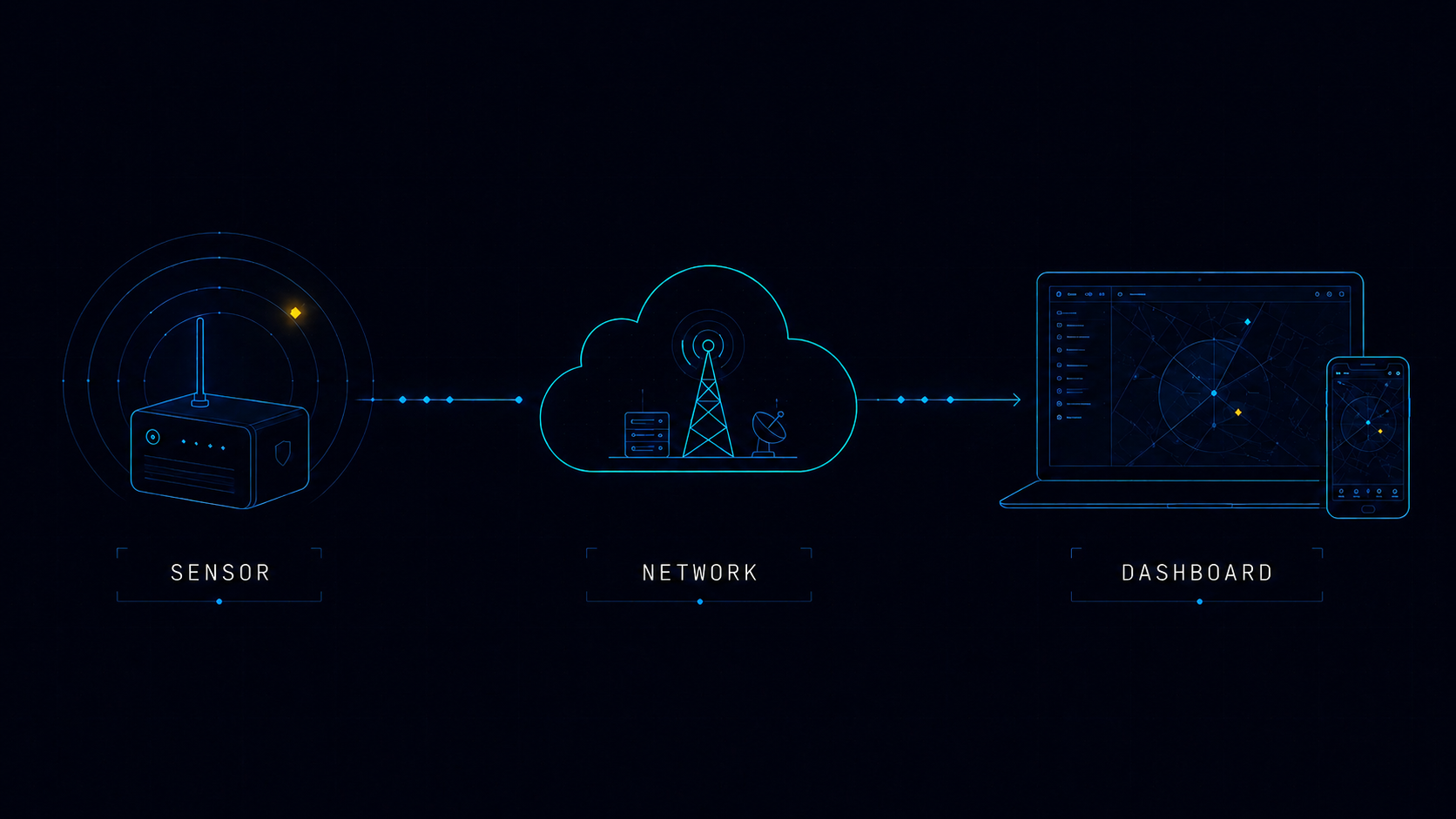
Guardius doesn't hunt for drones or probe the sky. It listens for the Remote ID broadcasts that compliant drones are already required to send, and turns them into clear, real-time awareness. Here's the whole path.
The sensor listens
Every compliant drone broadcasts a Remote ID signal — a kind of digital license plate carrying its ID, position, and altitude, plus the operator's location. The Guardius sensor listens for those broadcasts on the 2.4 and 5 GHz bands. It only receives. There is no transmitter and nothing aimed at the sky, so a sensor is passive, quiet, and simple to site.
The network fuses
Each sensor forwards what it hears to the Guardius cloud over your network. When several sensors hear the same drone, the platform fuses and de-duplicates those reports into one continuous track — so a single drone shows up once, with a cleaner position than any one sensor could give on its own.
The dashboard shows
Your team watches a live map on a laptop or phone. Each contact carries its telemetry; alerts fire when a drone crosses a ceiling you've defined. Every account sees only its own sensors and detections — multi-tenant by design, your data kept yours.
Honest by design
What Guardius sees — and what it doesn't.
We'd rather you trust the picture than oversell it. Here's the candid line between what this platform does and what it deliberately doesn't.
Detects
- Compliant drones broadcasting Remote ID
- Drone position and altitude in real time
- The operator's location, when the signal carries it
- Tracks against your published airspace ceilings
Does not
- Sub-0.55 lb, non-compliant, or non-broadcasting drones
- Jamming, takeover, or any interdiction (federally restricted)
- A guarantee of catching every drone in the sky
- Any claim to stop, disable, or remove a drone
Want to see it on your own airspace?
We'll walk you through a live picture and answer the honest questions — coverage, limits, and cost.